At a Glance
- Original name: Gunung Bromo
- Where: Bromo Tengger Semeru National Park, East Java
- Height: 2,329 m, inside the ancient Tengger caldera
- The draw: sunrise over the "sea of sand," a climb to the smoking crater
- Start: at night, for sunrise around 4–5 AM
- Best time: dry season (April–October)
- Getting there: gateway is Cemoro Lawang village; from Bali, a multi-day tour, often with Ijen
Mount Bromo (Gunung Bromo) is an active 2,329-meter volcano in East Java. It isn't the tallest peak in the Tengger massif, but it is the most famous: its smoking crater stands in the middle of a giant ancient caldera floored with a plain of sand, and sunrise over that otherworldly landscape is one of Indonesia's signature sights.
Why Visit
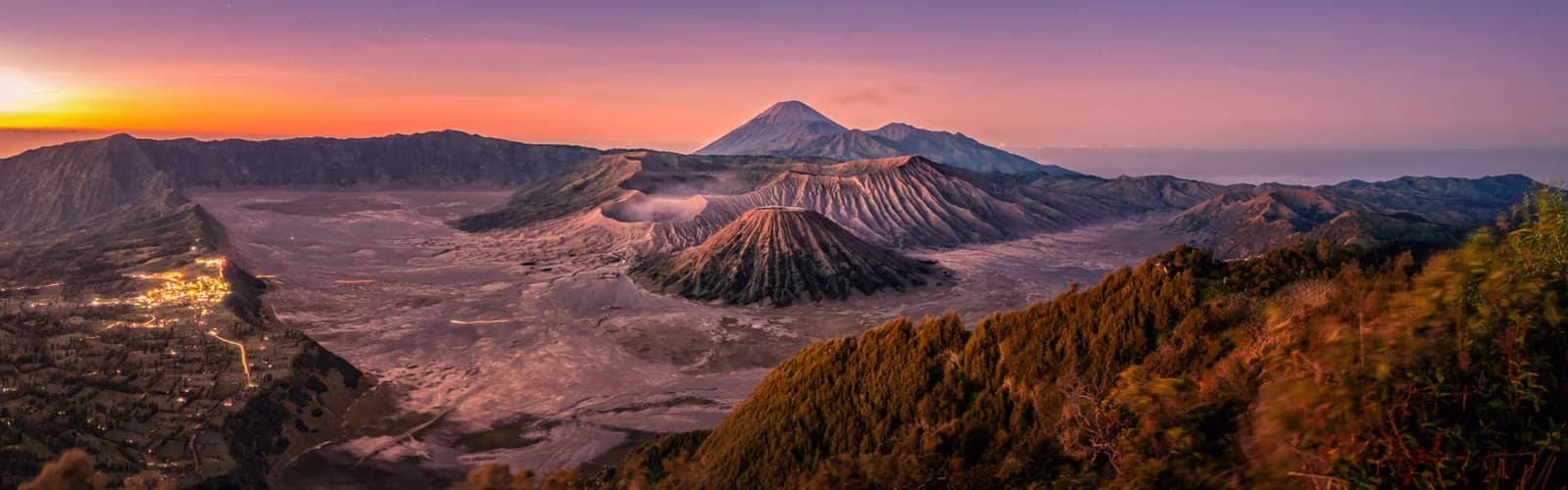
For that one shot: at dawn the sun rises through the clouds, and before you stand the cones of Bromo and Batok and the silhouette of Java's highest peak, Semeru, above a sea of mist. This isn't a beach day but an early-morning adventure for those willing to get up in the night and brave the cold for a grand view.
For travelers based in Bali, Bromo is a multi-day trip over to Java, usually paired with the Ijen volcano and its blue fire.
Sunrise Over the Caldera
The Bromo classic is to watch sunrise from a viewpoint on the slope of Penanjakan, at around 2,700 meters. You head up in the dark, usually by jeep. From the lookout you see three peaks at once: the smoking Bromo, the perfectly conical green Batok, and, in the distance, Semeru (3,676 m), Java's highest volcano, which puffs a column of ash every few minutes.
The Sea of Sand and the Crater
After sunrise the jeeps drop onto the caldera floor — the Sea of Sand (Laut Pasir), a wide volcanic plain of black ash. It's the only protected "sand sea" in Indonesia, and the landscape really does look like another planet.
From the base, a staircase of about 250 steps leads up to Bromo's crater. From the rim you can peer into the vent, where sulfurous smoke rises and the volcano rumbles. Part of the walk across the sand can be done on horseback, offered by locals.
The Tenggerese and the Temple
Around Bromo live the Tenggerese — Hindus, descendants of the Majapahit empire who kept their faith after Java turned to Islam. On the sand plain at the foot of the volcano stands the temple of Pura Luhur Poten.
Once a year the Tenggerese hold the Yadnya Kasada festival: they climb to the crater and throw in offerings — fruit, rice, vegetables, flowers, and livestock — as gifts to the mountain gods. The name "Bromo" itself comes from the god Brahma.
Getting There and When to Visit
- Gateway — the village of Cemoro Lawang on the northeastern edge of the caldera; jeep tours to the viewpoints and crater start here.
- From Bali — it's a multi-day trip: a ferry to Java and a long drive, so Bromo is almost always done as part of a tour, often together with the Ijen volcano.
- When — the dry season (April–October) is best, with a better chance of a clear, cloud-free sunrise.
- Warmth — before dawn at altitude it's cold, around 0–10 °C and windy; bring a warm jacket, hat, and gloves.
Combine Your Trip
Bromo pairs naturally with the other volcanoes of East Java. Most often it's done with Ijen — the volcano with a turquoise acid lake and its famous "blue fire." Towering nearby is Semeru, Java's highest and a far more serious climb.
FAQ
Is Mount Bromo active? Yes — it's an active volcano: sulfurous smoke rises constantly from the crater, with occasional ash eruptions.
What time does the tour start? At night: you head up to the viewpoint in the dark to reach it for sunrise around 4–5 AM.
Is the climb to the crater hard? No — a staircase of about 250 steps leads to the rim, and part of the walk across the sand can be done on horseback.
Can you do Bromo as a day trip from Bali? Not really — it's far. Bromo is usually visited on a multi-day tour, often together with Ijen.
Excursions visiting Bromo