Bali Airport Arrival: Visa, Baggage, SIM, Money, and Transfer
The first hour in Bali stays calm when your visa, arrival card, and transfer are ready beforehand — you don't have to solve it all in the arrivals hall.
What is Bali airport called and where do you arrive?
Bali's airport is officially I Gusti Ngurah Rai International Airport (DPS), sitting in South Bali near Kuta and Jimbaran.
Jimbaran and Kuta are the closest areas for a first night — Ubud and the north are noticeably farther and more traffic-sensitive.
What should you prepare before flying to Bali?
Before flying, sort your visa or e-VOA, arrival card, and customs declaration — the arrival card can only be submitted within 3 days of landing.
Keep a passport valid 6+ months, an onward ticket, QR codes, and your hotel address in English — saved offline, not just in your inbox.
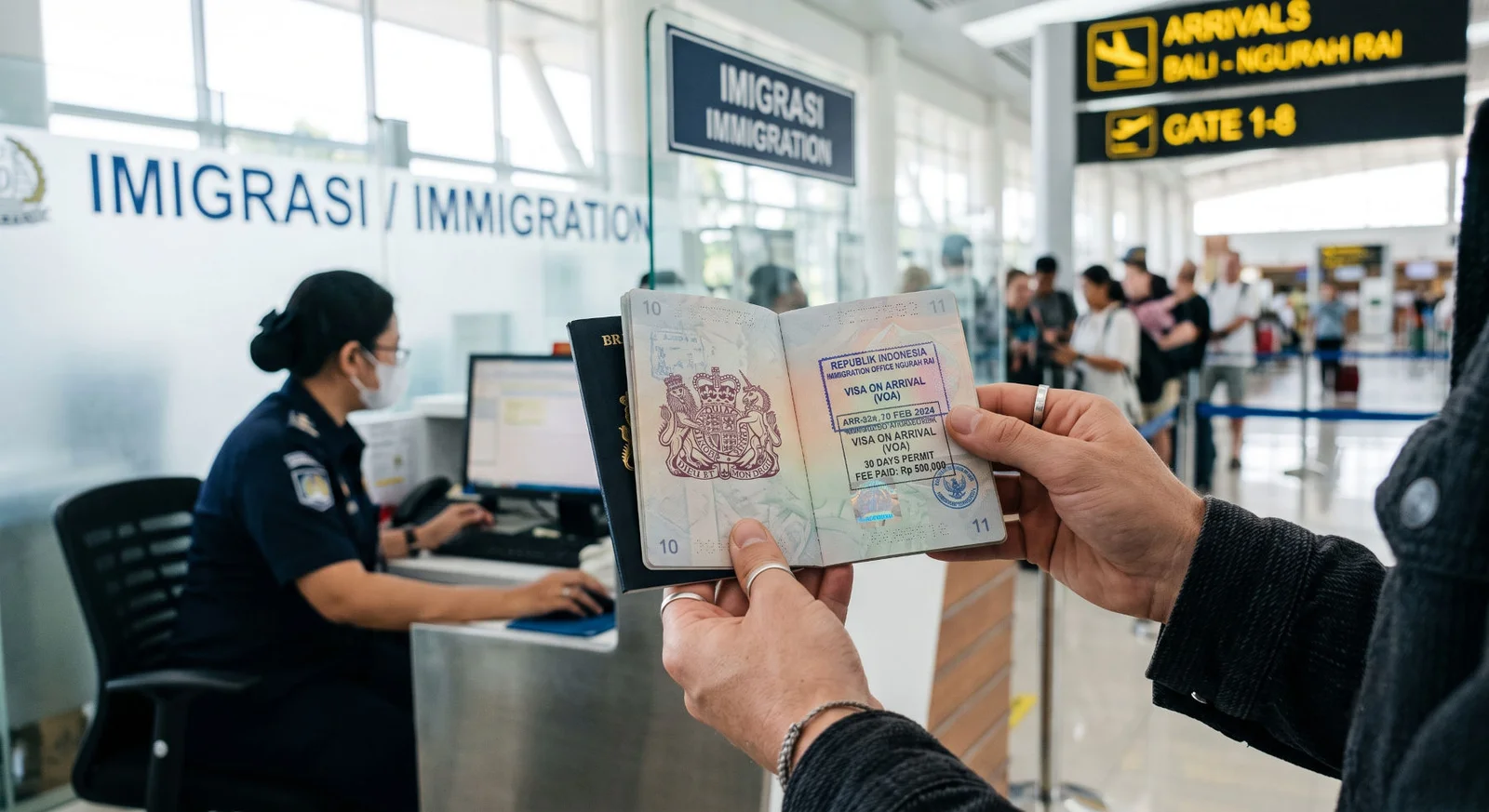
Most visitors get a Visa on Arrival (B1) — an IDR 500,000 fee, up to 30 days with one extension.
How do you move through Bali airport after landing?
After landing: immigration, baggage, customs, QR checks, connection, and the meeting point — one step at a time, no rush.
Landing with kids or after an overnight flight? Skip any activity that day — keep the evening for a shower, food, and real sleep.
Should you buy SIM or eSIM at Bali airport?
eSIM is easiest to sort before departure — maps, messaging, and your driver's contact all work the moment you land.
A local SIM is often better value for a longer trip and heavier data use, but registration usually needs your passport.
Where should you exchange money or withdraw cash at the airport?
You don't need to convert your whole trip budget at the airport — a small reserve for water, connection, and first costs is enough.
Cards from some home banks don't work reliably abroad — keep cash and a working card as separate backups, not one plan.
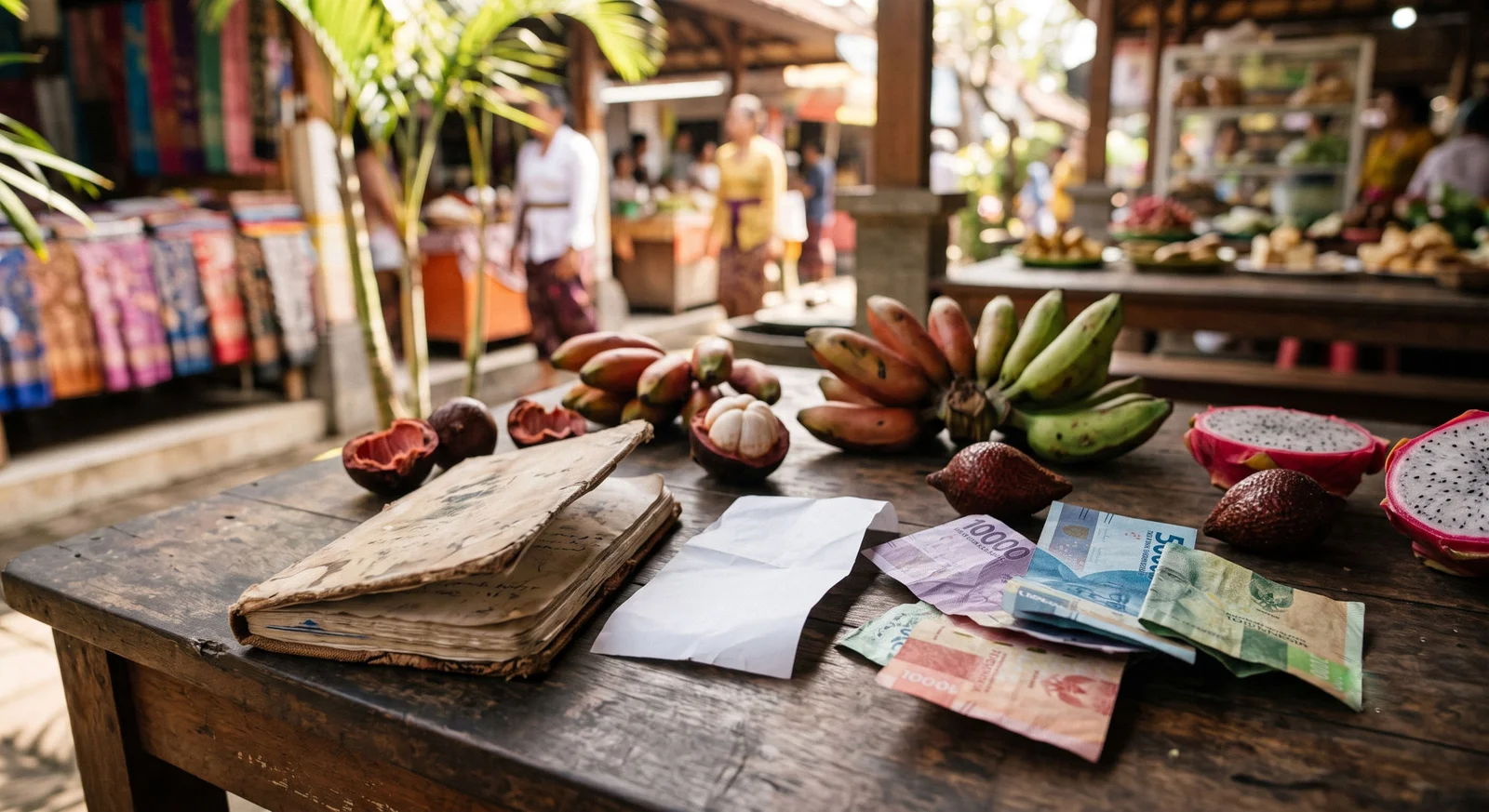
Cards work at ATMs and established venues, but cash in rupiah is what you'll need for warungs and small vendors.
How should you arrange a transfer from Bali airport?
A pre-arranged transfer is the calmest option for a first arrival, especially on a late flight or with children.
Kuta, Jimbaran, and Nusa Dua have the most transfer options, and the logistics there are the simplest.
Where should you go after landing: Kuta, Jimbaran, Nusa Dua, or Ubud?
Kuta and Jimbaran are easy near the airport, Nusa Dua is calmer for a beach start, and Ubud is better as a separate stage.
Landing late? Don't drive straight to the north or Amed — the same route is safer and more enjoyable after a night's sleep.
What is better not to solve in the first hour?
Don't solve everything in a rush at the airport — a random transfer offer, a big money exchange, or an argument at a control point can all wait.
Don't hand your passport to unofficial helpers, and don't get into a car without a clear price and confirmation.
Getting Around Bali: Taxi, Scooter, Driver, and Apps
Bali Airport Arrival: Visa, Baggage, SIM, Money, and Transfer
July 2, 2026
12 min read
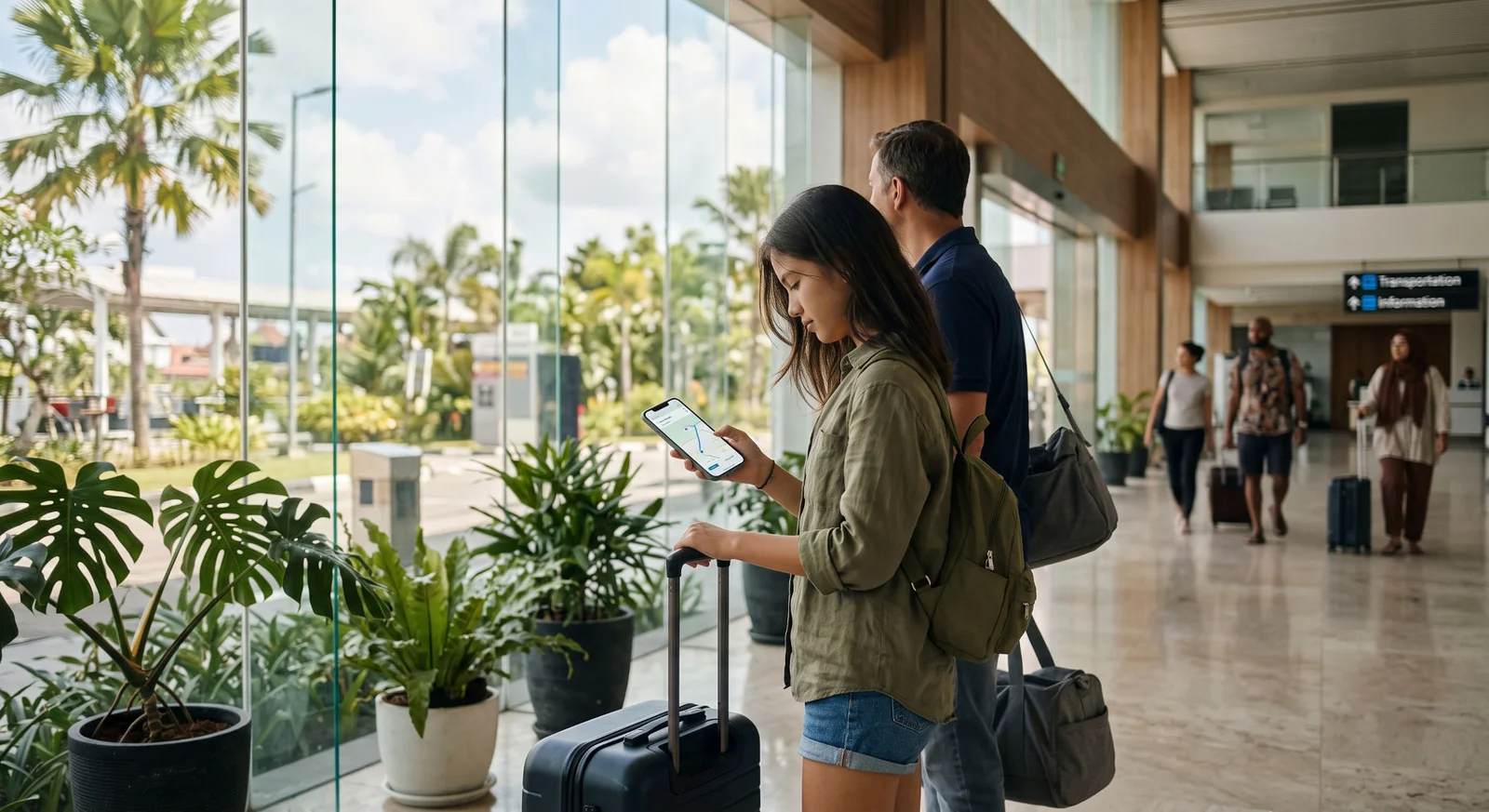
Bali's main airport is I Gusti Ngurah Rai International Airport, code DPS. It is often called Denpasar Airport, but after landing the useful question is simple: how to move through immigration, baggage, QR forms, connection, money, and hotel transfer without turning the first hour into a scramble.
The arrival flow is manageable when your visa or e-VOA, arrival card, customs declaration, hotel address, and transfer are ready before the flight. You do not need to solve everything in the arrivals hall; some decisions are better handled at the hotel or the next morning.
What is Bali airport called and where do you arrive?
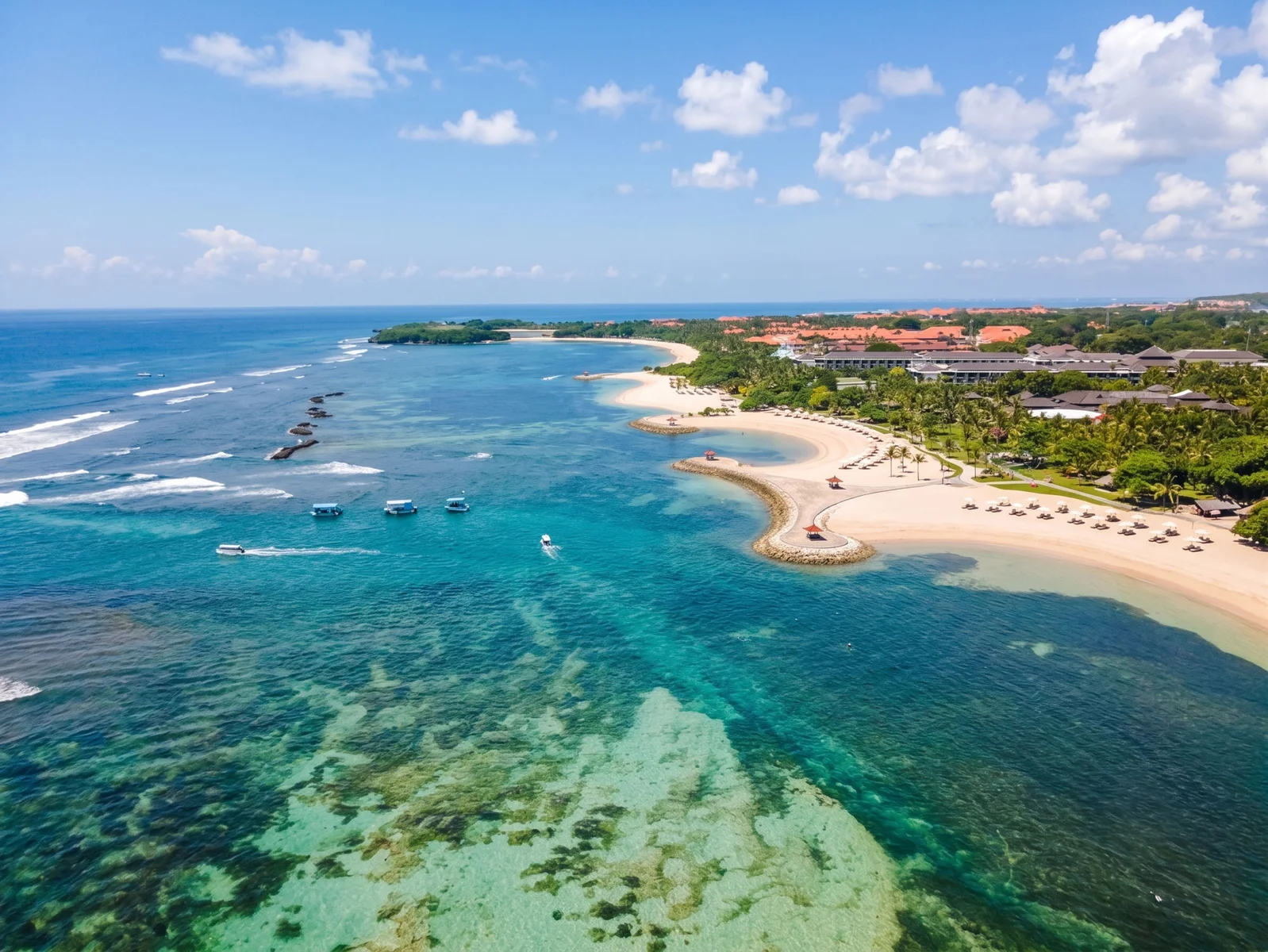
Bali's main international airport is I Gusti Ngurah Rai International Airport with the IATA code DPS. It is commonly described as Denpasar Airport, although it sits in South Bali near Kuta, Jimbaran, and the road toward Nusa Dua.
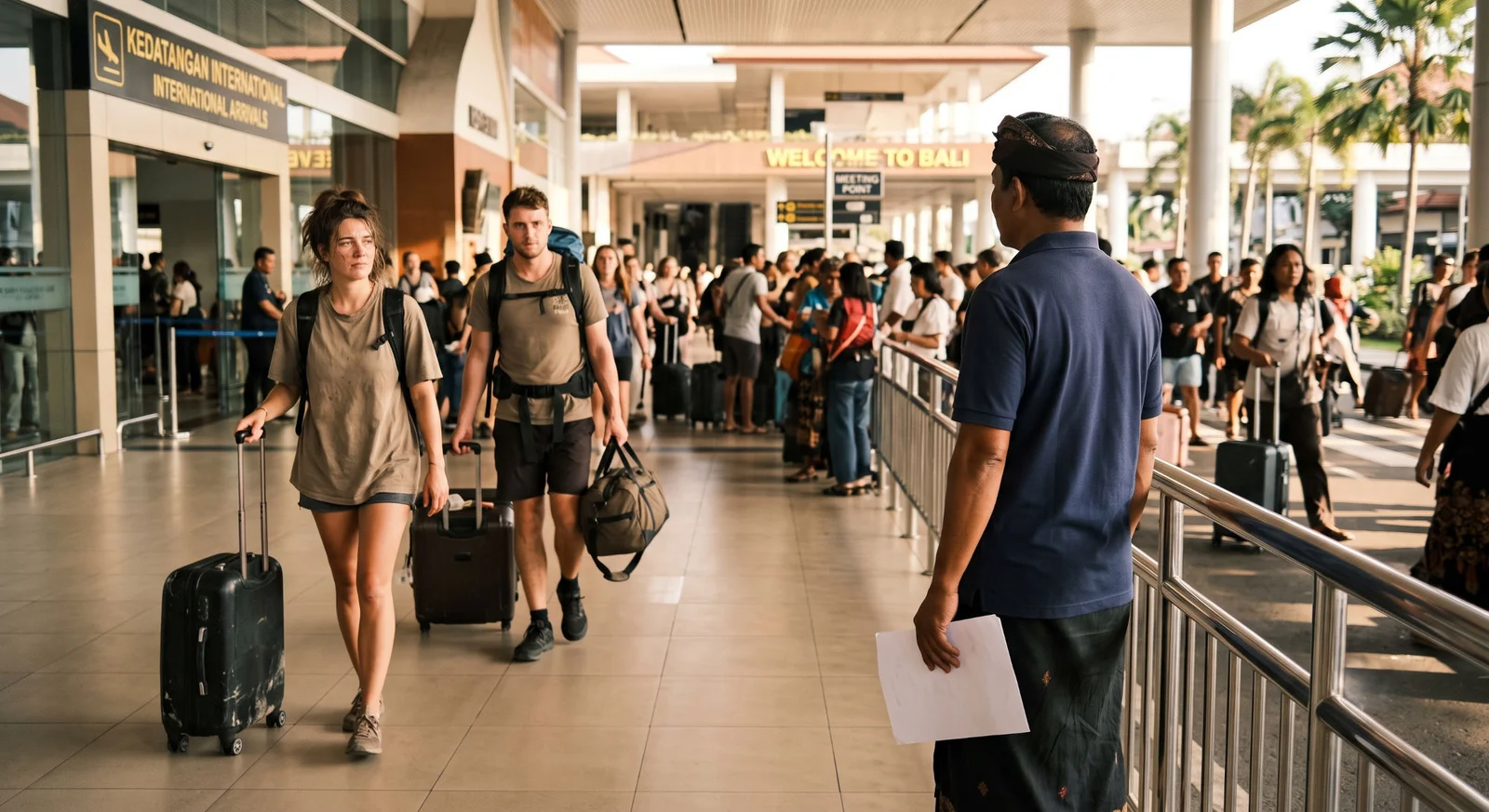
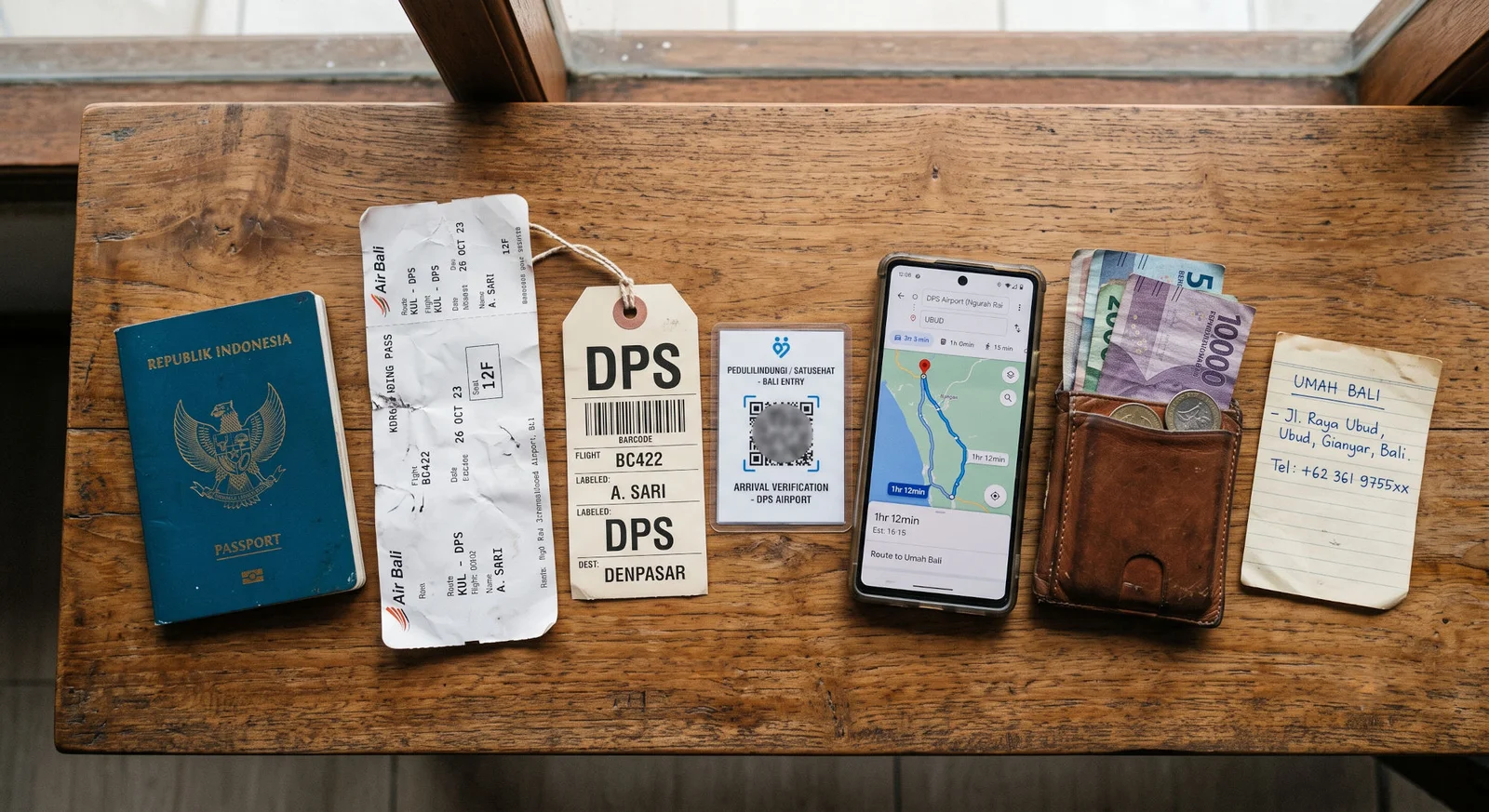
Bali airport arrival flow showing passport, baggage, QR codes, money, and transfer
For your first route:
Kuta and Jimbaran are among the closest first-night areas.
Nusa Dua is straightforward via South Bali roads.
Ubud takes longer and is more traffic-sensitive.
Canggu and Seminyak can be slow due to dense traffic.
North, East Bali, and Amed are better as daytime transfers.
Before flying, prepare more than your ticket and passport: the correct visa route, electronic arrival card, customs declaration, and Love Bali tourist levy if you prefer paying before arrival. The official Indonesia eVisa site states that all travelers must submit an arrival card within 3 days before arrival.
Visa handling depends on your nationality. Some visitors use ASEAN visa exemption, many use Visa on Arrival or e-VOA, and others need a visitor visa before travel. Always check the official eVisa portal for your passport and purpose of visit, especially if you plan a long stay, business activity, multiple entries, or non-refundable flights.
Before departure, check:
passport validity of at least 6 months from arrival;
onward or return ticket;
correct visa route for your nationality;
arrival card and QR code;
customs declaration for arrival;
Love Bali tourist levy voucher if paid in advance;
first hotel address written in English.
Save screenshots of QR codes and keep your visa PDF offline. Airport internet is usually available, but showing a ready file is easier than searching email after a long flight.
FAQ: documents before arrival
Yes, but for most travellers it is issued on arrival. Around 87 nationalities — including the US, UK, EU countries, Australia and Canada — are eligible for Indonesia's Visa on Arrival (code B1): a fee of IDR 500,000 (~USD 35) for a stay of up to 30 days, extendable once by another 30 days (60 days total). A separate Bali tourist levy of IDR 150,000 per person is paid online through the official Love Bali portal. Always confirm your own passport against the official Imigrasi subject-country list before you fly, as eligibility, fees and rules can change.
It's a mandatory electronic arrival card (All Indonesia Arrival Card) for everyone entering Indonesia, Bali included. Fill it online within 72 hours before arrival at the official allindonesia.imigrasi.go.id or the app — submit it earlier than 3 days and the system won't accept it. From your passport details you get a QR code (by email) that officers scan at immigration, health and customs. The card is free — don't pay third-party services. It's separate from your visa and doesn't grant entry on its own.
Duty-free per person you can bring roughly: 200 cigarettes (or 50 cigars / 100g tobacco), 1 litre of alcohol, and personal goods up to USD 500; you must declare cash over IDR 100 million (~USD 6,500). The declaration is filed electronically (e-CD, often part of the 'All Indonesia' card) — a QR code is scanned as you leave baggage reclaim. Customs are strict: limits are per person and can't be pooled, and over-limit alcohol is confiscated. Undeclared restricted goods can mean seizure and a fine.
The Bali tourist levy is IDR 150,000 per foreign tourist. It's easiest to pay online in advance at the official lovebali.baliprov.go.id portal or the Love Bali app (you'll need your passport, name, email and arrival date); you'll get a QR voucher by email that's scanned at a dedicated 'Levy' lane at Denpasar airport. If you haven't paid, BRI bank counters in the arrivals hall take cash or card. Accepted methods include cards, bank transfer, UnionPay and QRIS. KITAS/KITAP holders are exempt.
How do you move through Bali airport after landing?
After landing, the usual flow is immigration, baggage, customs, QR checks, connection, money, and transport. The most comfortable approach is to handle each step in order and avoid loading the first hour with unnecessary decisions.
Basic sequence:
Follow Arrivals / Immigration signs.
Prepare your passport, boarding pass, and pre-approved visa/e-VOA if applicable.
Collect baggage after passport control.
Show your customs QR code or complete the form if you have not done it.
Check whether the Love Bali tourist levy counter applies to your arrival flow.
Sort connection and a small amount of cash only if you need them before the hotel.
Go to your confirmed driver, hotel transfer, or official transport.
If you arrive with children or after an overnight flight, keep the same day simple. The first evening is for shower, food, hotel check-in, messaging, and sleep.
Should you buy SIM or eSIM at Bali airport?
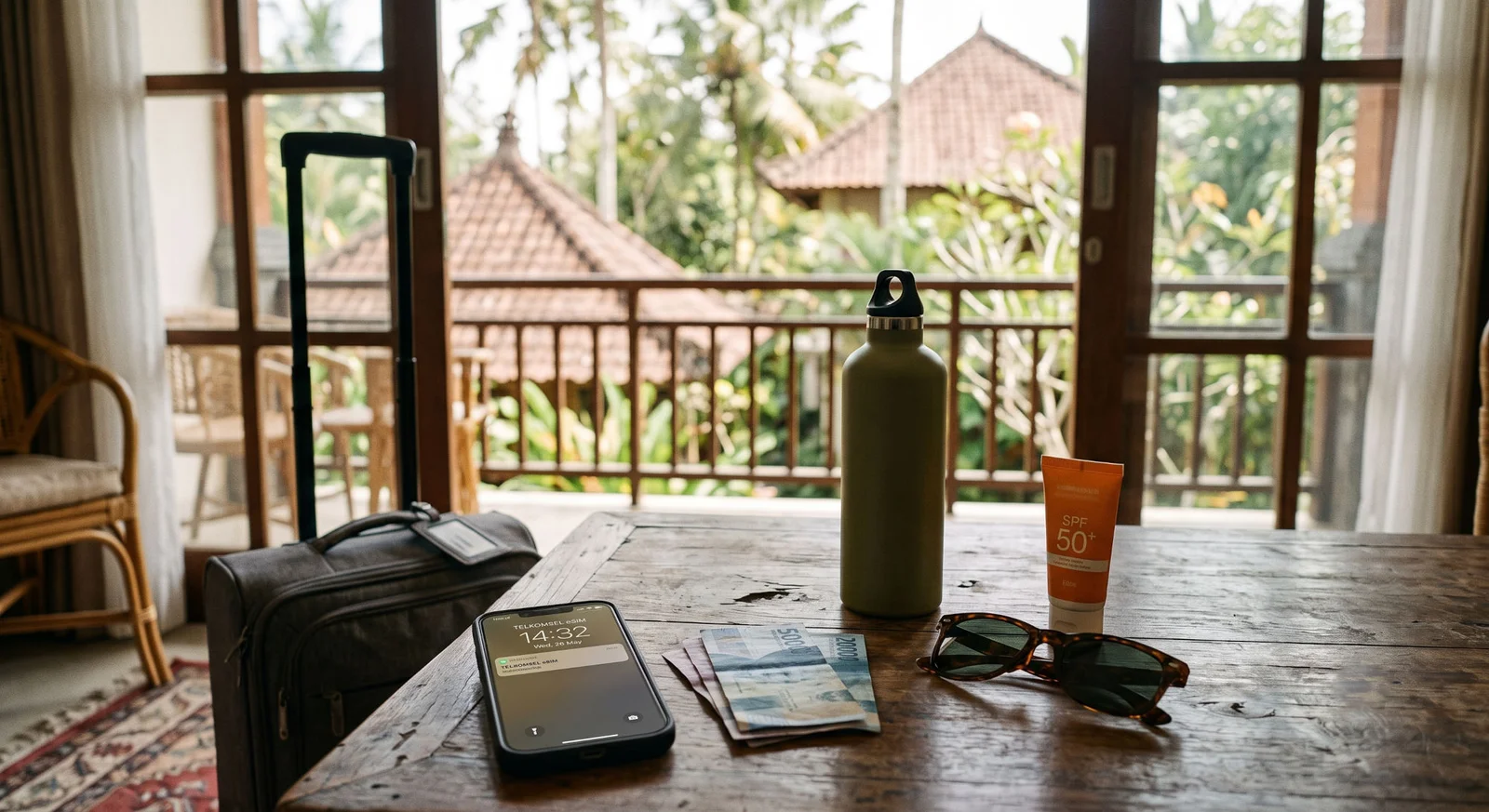
For the first day, eSIM before departure is often the easiest option because maps, messaging, and driver contact work as soon as you land. A local SIM can be bought at the airport or later in a tourist area, but registration usually requires a passport and the best option depends on trip length.
Choose by scenario:
eSIM: useful for immediate connection and shorter stays.
Local SIM: often better for longer trips and heavy data use.
Hotel Wi-Fi: useful backup, but not enough for airport transfer and navigation.
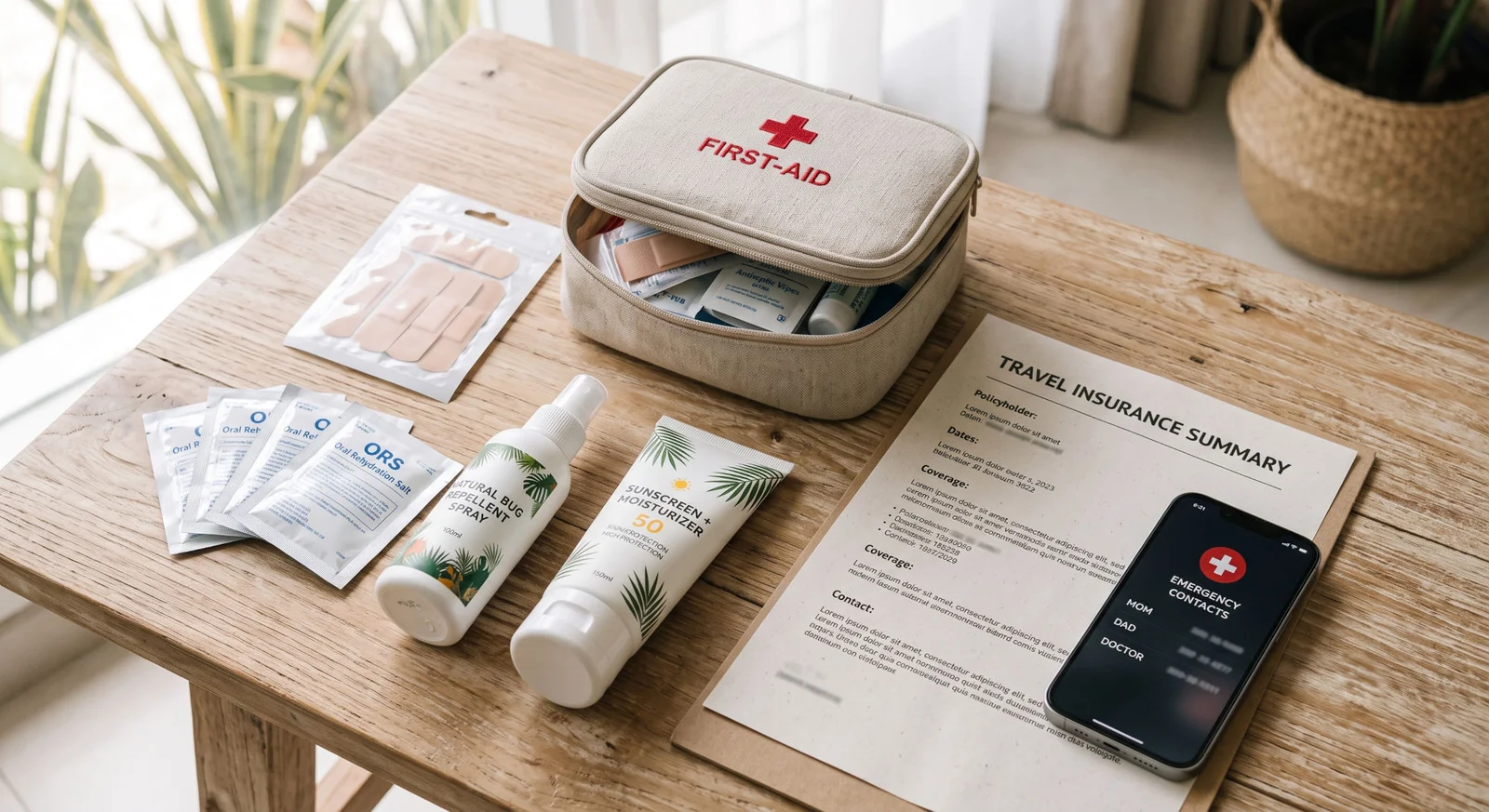
Whatever you choose, save your hotel address, driver contact, QR codes, booking confirmations, and important documents offline before boarding the flight.
FAQ: connection after landing
For the best coverage (including rural areas and islands like Nusa Penida and the Gilis) choose Telkomsel; XL is a good budget option in towns, and Indosat suits short stays. Tourist starter packs with data are cheap and easily cover a couple of weeks. A SIM must be registered with your passport — done at an operator's office or an authorised retailer. Buy at Denpasar airport, phone shops or minimarkets. A convenient alternative is an eSIM, which you can set up online before you fly.
For a normal trip, no. But if you're staying long-term (roughly over 90 days) and using a local SIM, you may need to register your phone's IMEI with customs (a fee may apply), or the local network will eventually block it. On roaming or Wi-Fi only, no registration is needed. The rules change from time to time — check current requirements with customs (Bea Cukai).
Indonesian (Bahasa) is simple and friendly, and locals love a few words. Handy ones: 'terima kasih' — thank you, 'sama-sama' — you're welcome, 'selamat pagi/siang/malam' — good morning/afternoon/evening, 'permisi' — excuse me (to get attention), 'maaf' — sorry, 'berapa?' — how much?, 'ya / tidak' — yes / no. English is understood in tourist areas, but even a simple 'terima kasih' goes a long way.
Where should you exchange money or withdraw cash at the airport?
You can exchange money or use an ATM at the airport, but you do not need to convert your entire trip budget there. For the first day, a small cash reserve is enough for water, tips, parking, small purchases, or a backup payment.
Travelers from major Bali markets often use cards in hotels, restaurants, and established venues, but Bali is not fully cashless. Markets, small warungs, parking, local entrances, and some rural stops still work better with cash.
Practical approach:
carry some exchangeable cash in good condition;
avoid changing a large amount with random helpers;
check rate and final amount before handing over cash;
do not rely on only one card or one wallet;
keep backup cash separate from your main wallet.
A balanced arrival setup is simple: some clean cash in a widely accepted currency, one or two cards that work abroad, offline booking screenshots, and a realistic budget for the first 24 hours.
FAQ: airport money and payments
Your Visa and Mastercard work at bank-owned ATMs and in established hotels, restaurants and shops (UnionPay is also accepted at 90%+ of ATMs). Withdraw cash at ATMs attached to bank branches (Mandiri, BCA, BNI, BRI, Permata) for safety, and watch for foreign-transaction and ATM fees. Keep cash in rupiah for everyday spending — warungs, markets, small shops and transport are often cash-only — while cards and QR payments cover the bigger venues.
Use only licensed money changers: an official one displays a 'PVA Berizin' sticker and registration number (Bank Indonesia), and you can verify the licence on Bank Indonesia's portal. Reliable names are BMC and Central Kuta, or exchange inside a bank. Avoid booths offering rates well above the market (more than ~3% better) and the 'fast-fold' trick, where the cashier slips notes back out while counting — count the cash yourself and don't rush. Many travellers skip exchange entirely and simply withdraw rupiah from a bank-owned ATM.
Most ATMs dispense roughly IDR 1,250,000–3,000,000 per withdrawal (BCA and BNI are usually 1.25–2.5M). Fees: your home bank charges for an overseas withdrawal (often 2–8%), and from 2026 Mandiri adds an IDR 50,000 fee for foreign cards; BCA and BNI more often have no local fee. Always choose rupiah, not 'conversion' (DCC), for a better rate. Use ATMs attached to bank branches for safety and to reduce the risk of card skimming.
QRIS is Indonesia's single QR-payment standard (from Bank Indonesia), accepted almost everywhere in tourist areas. Travellers from partner countries (Singapore, Malaysia, Thailand, Japan, Korea, China) pay by scanning a QRIS code with their own banking app. Others can use a local e-wallet (GoPay, OVO) — verify with your passport and a local SIM, then top up by linking an international card. If that's a hassle, ordinary cards and cash work fine everywhere tourists go.
How should you arrange a transfer from Bali airport?
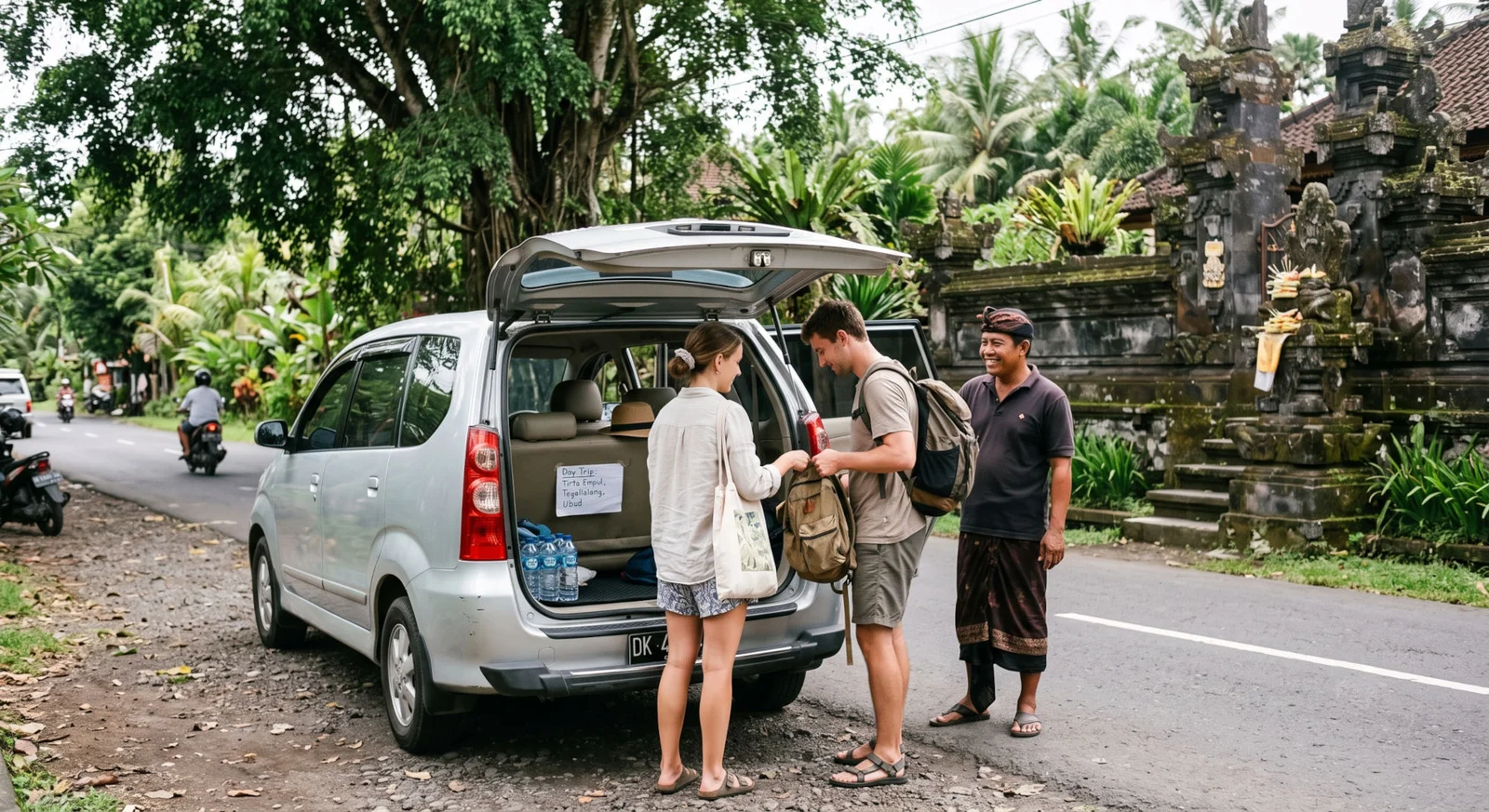
For a first arrival, a pre-arranged transfer is the calmest option, especially after a late flight, with children, or when going beyond the closest areas. Taxis and ride-hailing apps can work, but after a long flight it is easier to have a meeting point, fixed expectation, and driver contact ready.
For Ubud, Canggu, East Bali, and the north, book transfer before landing. For Kuta, Jimbaran, and Nusa Dua, there are more options, but clear logistics still save energy after the flight.
FAQ: airport transfer
Yes. To book a transfer, please provide your flight number, arrival time, and hotel name. Our driver will meet you in the arrivals hall with a 'BALITOURUS' sign. Read more in [Transfer & Taxi](/en/transfer-i-taksi).
For most visitors a car with a driver is easier and less stressful: they know the roads, handle parking and navigate the chaotic, left-hand traffic while you enjoy the view — it's a popular, affordable choice for full-day sightseeing. Self-drive without a driver suits confident drivers who hold an International Driving Permit and are ready for local traffic. For trips around the island and transfers we arrange a car with an English- or Russian-speaking driver — just message us.
Tours are conducted in comfortable Japanese minivans such as Suzuki APV or Toyota Avanza (up to 5 passengers). For larger groups, we provide spacious Toyota HiAce minibuses.
Where should you go after landing: Kuta, Jimbaran, Nusa Dua, or Ubud?
After a long flight, go somewhere where check-in, food, and rest are easy. Kuta and Jimbaran are convenient near the airport, Nusa Dua is calmer for a beach start, and Ubud is better as a separate stage unless you land early enough for the drive.
Quick area logic:
Kuta: close and easy for one night, but active and busy.
Jimbaran: softer start, beach dinner, near the airport.
Nusa Dua: calmer resort base, good with children.
Ubud: better by day or with pre-arranged transfer.
Uluwatu: beautiful, but inconvenient without clear transport.
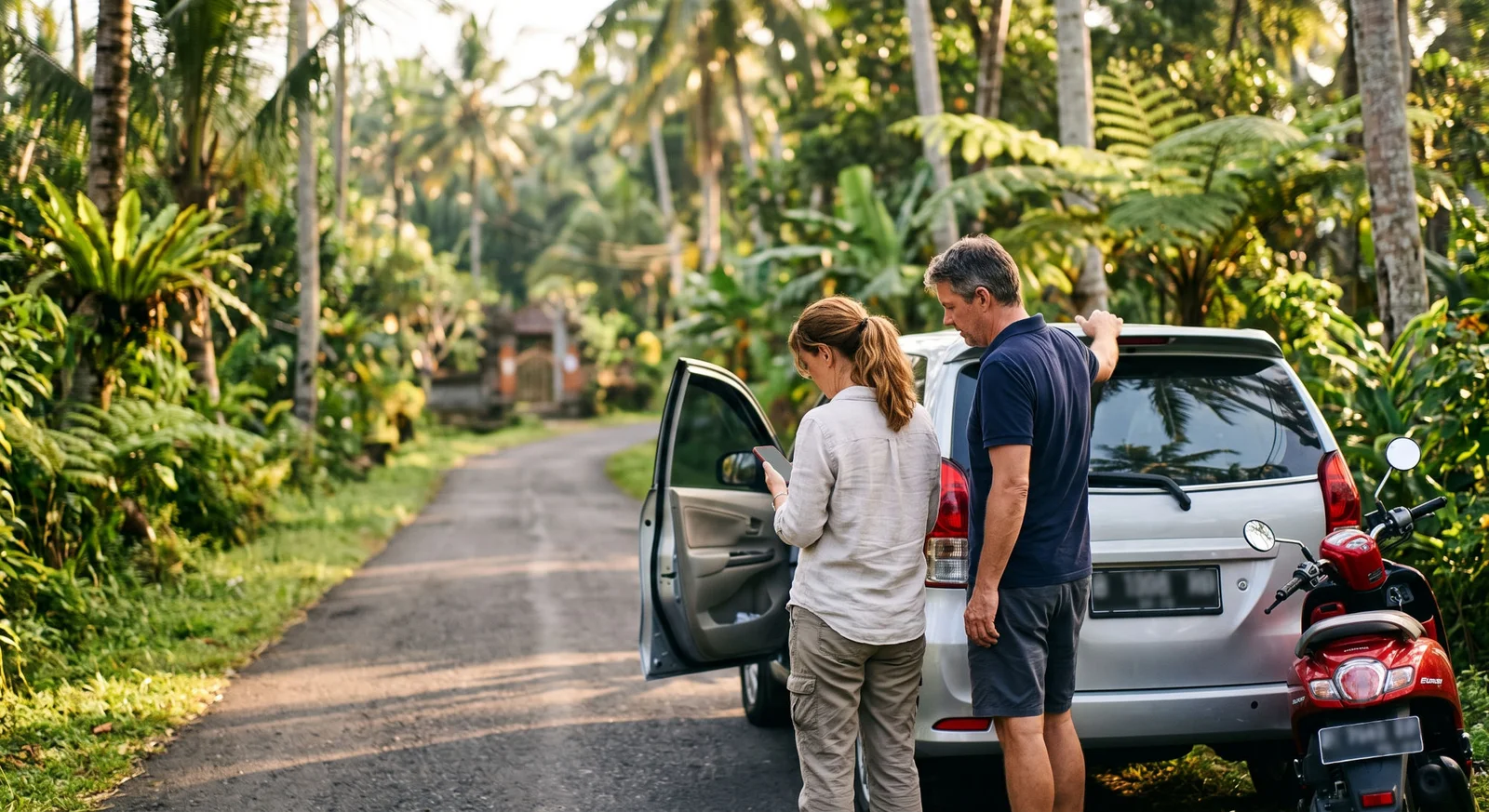
If you land late, do not drive straight to the far north, Amed, or remote waterfalls. After sleep, the same route will be safer and more enjoyable.
What is better not to solve in the first hour?
At Bali airport, do not try to solve every travel issue in a rush: random transfer offers, large money exchange, the "best SIM deal" after a night flight, or arguments at control points. Move through formalities calmly, reach the hotel, and return to complex decisions after rest.
A few sensible boundaries:
do not hand your passport to unofficial helpers;
do not show all your cash in public;
do not exchange a large amount without checking the rate;
do not get into a car without clear price, contact, or confirmation;
do not throw away boarding pass or QR codes before leaving the airport;
do not schedule a long route immediately after the flight.
The goal of your first hour in Bali is simple: leave the airport calmly, stay connected, and reach the hotel safely. Everything else can wait until after rest.
FAQ: Bali airport
A passport valid for at least 6 months from your date of entry, with blank pages for the stamp, plus a return or onward ticket. Most visitors get their visa at the airport (Visa on Arrival), while the Bali tourist levy and the electronic customs declaration are easiest to handle online before you fly. Requirements are updated from time to time, so check the official Imigrasi guidance for your nationality before travelling.
Yes, proof of onward travel is required: Indonesia's rules ask for a return or onward ticket out of the country (airlines check this at check-in more often than immigration does). Holding an exit ticket doesn't stop you extending later — immigration only wants to see that, at the moment of entry, you have the means and intention to leave. So you can hold a ticket dated beyond the first 30 days, or a flexible/refundable one, and still extend your Visa on Arrival once for another 30 days on the island (since June 2025 extensions are done in person at an immigration office).
Yes — holders of modern biometric passports can often use the automatic gates (autogate / smart gate) at Denpasar airport, which is faster (about 2–5 minutes) with no manned queue. Everyone else goes to an officer as usual. Autogate eligibility depends on your passport and visa type and changes from time to time. You still need your visa, tourist levy and arrival card sorted in advance — the autogate only speeds up the crossing itself.
Tipping in Bali is not obligatory, but it's appreciated for good service. Hotels and restaurants often already add a 10% service charge and 11% tax (shown as '++' or 'service charge') — then no extra is needed. Where there's no service charge (warungs, small cafés), leaving 5–10% in cash is a nice gesture. As a guide: a driver-guide for the day IDR 50,000–100,000, a spa therapist IDR 20,000–50,000, ride-hailing +IDR 5,000–10,000. Tip in cash, directly to the person so it actually reaches them.
We use mandatory cookies to load the site correctly and optional cookies for analytics and marketing. By authorising their use, you agree to our cookie policy.