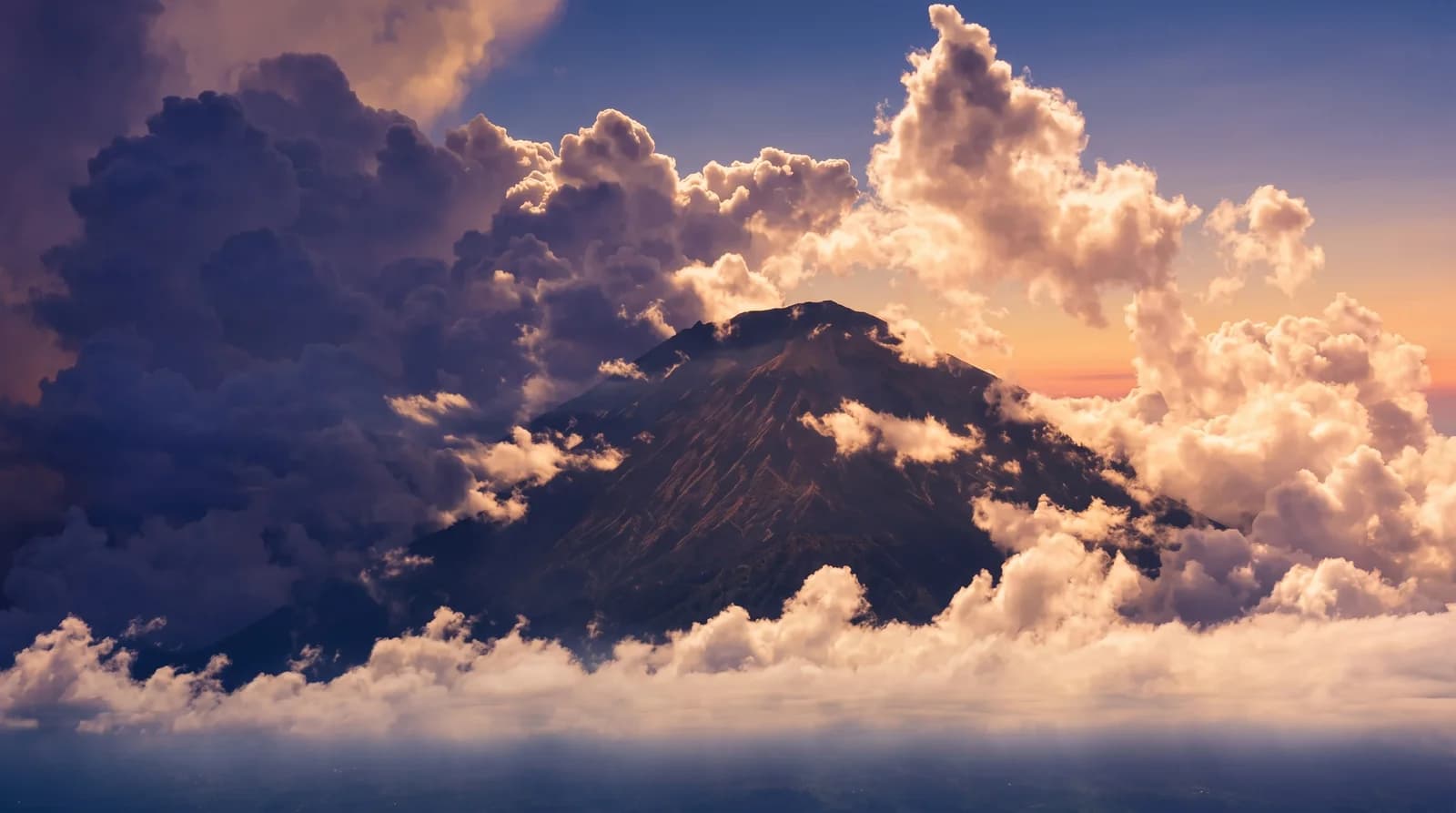
At a Glance
- Local name: Gunung Agung
- Height: 3,031 m — the highest point on Bali
- Where: Karangasem regency, east Bali
- The climb: 3–4 hours (from Pasar Agung) or 6–7 hours (from Besakih) one way
- Trek start: at night (around 11 PM or 2 AM) to reach the top for sunrise
- Best time: dry season, April–October
- Important: licensed guide required; the mountain closes for religious ceremonies
Mount Agung (Gunung Agung), standing 3,031 meters high, is the highest point and spiritual heart of Bali. It is an active stratovolcano the Balinese revere as the home of the gods and the orientation point for all of life — and, at the same time, the island's most demanding peak for a sunrise trek.
Why Climb It
Agung isn't a walk but a real ascent: a night start, steep volcanic scree, and over 1,500 meters of elevation gain. The reward is sunrise above a sea of clouds, when the first light catches the cone of neighboring Mount Batur and, on the horizon, Mount Rinjani on the island of Lombok.
The trek suits fit travelers ready to hike in the dark for several hours. Anyone who wants the same sunrise colors with far less effort is usually pointed to nearby Mount Batur — half the height and much more accessible.
The Sacred Mountain of the Balinese
Agung is the axis mundi of the Balinese world, the reference point for the entire island. The "kaja" direction (toward the mountain) is considered pure and auspicious: the Balinese sleep with their heads pointing toward Agung, and major temples and household compounds are oriented to the summit.
In Balinese Hinduism, the mountain is a fragment of the mythical Mount Meru, the center of the universe, carried to Bali by the god Pasupati to anchor and balance the island. On its southwestern slope, at around 1,000 meters, stands Besakih — the "Mother Temple," the largest and holiest temple complex on Bali.
The 1963 Eruption
The eruption of Agung in 1963–1964 was one of the largest volcanic events of the 20th century (VEI 5). Pyroclastic flows and lahars destroyed dozens of villages and claimed more than 1,100 lives.
The eruption holds a special place in Balinese memory: the lava flows stopped just meters short of Besakih Temple, sparing the shrine. Locals read this as a sign — the gods demonstrating their power without destroying the temple.
That same eruption has an unexpected underwater echo. The tremors of 1963 pushed the rusting hull of the US Army transport USAT Liberty off the beach and into the sea at the village of Tulamben — today one of the most famous shipwreck dives in the world.
Recent Activity
After half a century of quiet, Agung stirred again: a series of ash-venting eruptions ran from 2017 to 2019. Tens of thousands of residents were evacuated from the zone around the crater, and ash columns repeatedly closed Denpasar airport and grounded flights.
The volcano is calm today but remains active and under constant monitoring. Before you travel, it's worth checking the current activity status and the exclusion zone around the crater.
The Two Trekking Routes
Two main routes lead up Agung, and both start at night to reach the top for dawn.
From Pasar Agung Temple (Pura Pasar Agung) is the shorter route to the crater rim at about 2,866 meters. The climb begins around 2 AM and takes 3–4 hours one way. It offers a view into the crater but does not reach the true summit.
From Besakih Temple (Pura Besakih) is the long, hard route to the true summit at 3,031 m. It starts around 11 PM and takes 6–7 hours to ascend alone, hiking through most of the night. This is the option for the experienced and well-conditioned.
In both cases the climb is done only with a licensed local guide — you won't be allowed up without one, and it's a matter of safety as much as etiquette on the steep scree in the dark.
When to Go and What to Know
The best time to climb is the dry season, roughly April to October. In the rains the steep trails of loose volcanic gravel turn slippery and dangerous, and cloud erases the view.
- Ceremony closures. During major religious festivals at Besakih, the slopes of Agung close to tourists out of respect for ritual purity. The dates shift with the Balinese calendar, so check the status ahead of time.
- Gear. Bring a warm jacket (the summit can be 5–10 °C with strong wind), a headlamp, gloves, water, and shoes with good grip.
- Fitness. The elevation gain and night start demand real conditioning; first-time hikers should be honest about their level.
- Respect the shrine. This is a sacred mountain: keep your behavior modest, don't make noise, and never undress for photos — that kind of conduct is exactly why Bali has been tightening access rules to its mountains.
Combine Your Trip
Agung is the heart of east Bali, surrounded by sights for a full itinerary. The "Mother Temple" of Besakih sits on its slope; not far away are Lempuyang temple with its photogenic "Gates of Heaven" and the Tirta Gangga water palace. On the coast below the volcano lies the dive village of Tulamben, and for an easier sunrise trek there's neighboring Mount Batur.
FAQ
How hard is climbing Agung? It's a tough night trek with over 1,500 m of elevation gain on steep scree. You need good fitness; beginners are usually steered toward Mount Batur instead.
Do I need a guide? Yes. The climb is only permitted with a licensed local guide — a mandatory rule and a safety necessity.
When is the best time to go? In the dry season, April to October, starting at night to reach the summit or crater rim for sunrise.
Can I climb on any day? No. The mountain closes periodically for religious ceremonies at Besakih, and for safety during any volcanic activity. Always check the current status before you travel.
Excursions visiting Agung